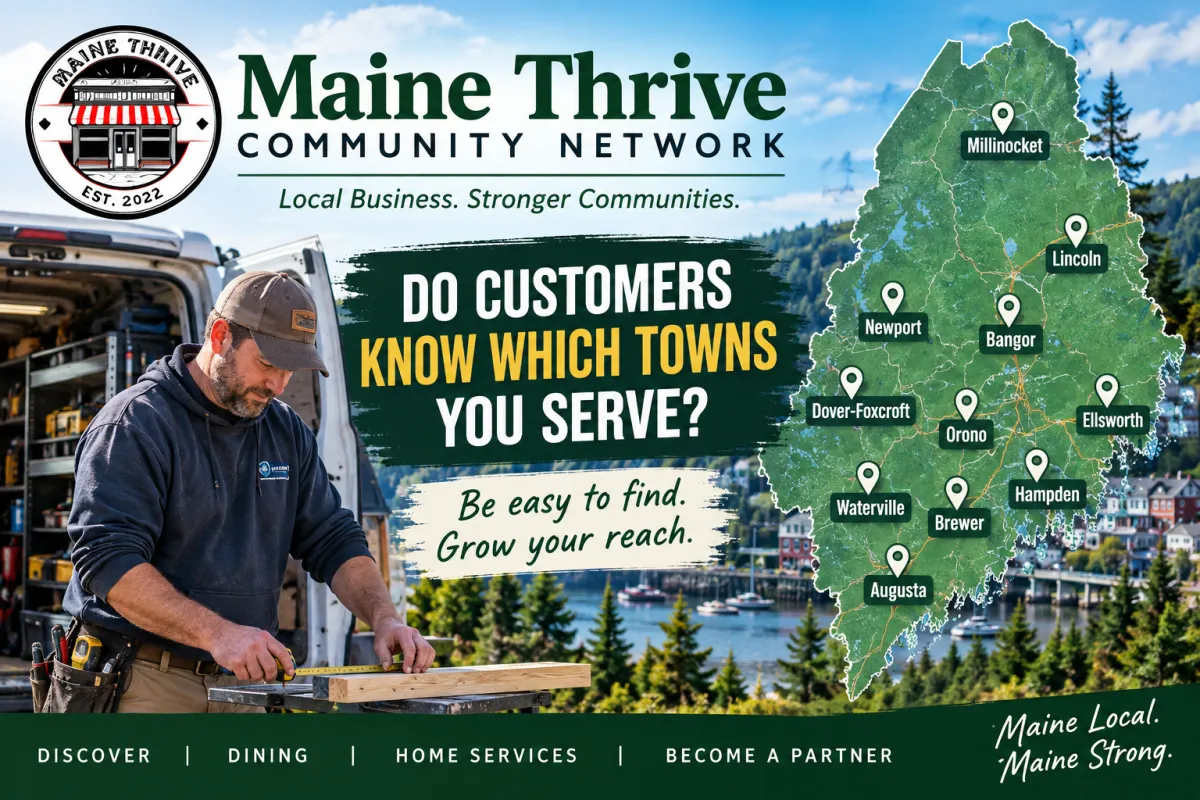
If You Serve a Town, Your Business Information Should Make That Clear
One of the simplest questions a local customer asks is also one of the easiest for a business to leave unanswered: Do you serve my town?
A business can be based in Bangor and serve several surrounding communities. Another may have a storefront in one town but draw customers from an entire region. The important thing is not pretending to have locations everywhere. It is making the real geography easy to understand.
A strong Maine Thrive Profile should help a customer answer that question quickly: where the business is based, what it does, which communities it serves and how to reach it.
Customers Think in Town Names
People do not usually search for a radius. They search for a painter in Hampden, dog boarding near Bangor, a restaurant in Brewer or a service company that will come to Old Town.
Named communities are meaningful. If a business genuinely serves those places, the information should say so plainly.
A Storefront and a Service Area Are Different
A storefront tells customers where they can visit. A service-area business may travel to customers and never receive the public at its business address.
Good local information should not blur those models. Accuracy builds trust, and it also gives search and AI systems a cleaner picture of the business entity.
What a Useful Profile Should Include
A useful local Profile should make the business name, primary services, real service geography, website, phone and other important facts easy to find. Hours belong where they are relevant. So do service details and meaningful Tags that help people discover the business by need.
The goal is not to stuff town names into every sentence. It is to make the basic facts complete enough that a customer does not have to leave the Profile to answer a simple local question.
Why Consistency Helps Discovery
When a business website, Google Business Profile and trusted community sources all describe the same business in compatible ways, there is less ambiguity.
Maine Thrive is one more local source that can reinforce the same true information - not replace the business website or Google, but add another credible regional reference point.
The Local Test
Open your business Profile and ask: If I lived one town away, would I know whether this company serves me? If the answer is not obvious, the Profile has work to do.
Quick Answers / Q&A
Why should a local business list the towns it actually serves?
Because customers search and make decisions using real place names. Clear service geography reduces uncertainty and helps people understand whether the business is relevant to their community.
Should a business claim a location in every town it serves?
No. A service area is not the same as a physical location. Businesses should accurately state where they are based and which communities they serve without implying storefronts that do not exist.
What should a Maine Thrive Profile make clear?
At minimum: the business name, what it does, the communities it genuinely serves, how to contact it, its website and other useful current details such as hours where relevant.
Does a Maine Thrive Profile guarantee Google or AI rankings?
No. A Profile is one trusted local source of factual business information. Visibility depends on many signals, and no single profile guarantees rankings or AI recommendations.
How does consistent service-area information help AI systems?
Consistent named entities, locations and service facts are easier to reconcile across sources. That can reduce ambiguity about what a business does and where it operates.
